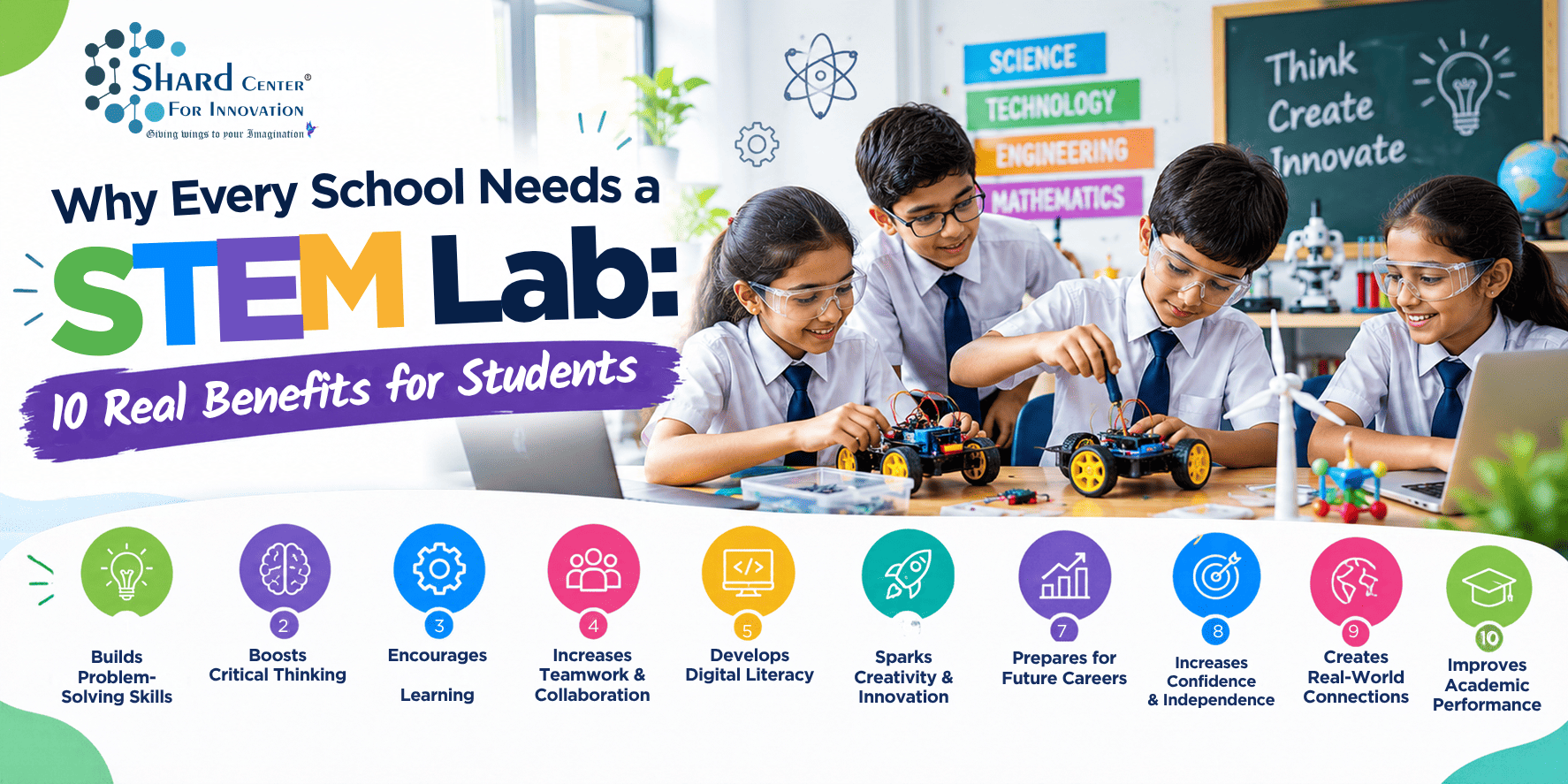
A STEM lab is one of the most important learning spaces for students in a school, as it promotes technological development and scientific knowledge—it can make students practically understand the concepts that they learn in textbooks and change the way they approach problems. Why Every School Needs a STEM Lab: 10 Real Benefits for Students delineates the benefits that students can experience through a STEM lab in their school.
What Is a STEM Lab—and What Makes It Different From a Regular Science Lab?
A STEM lab is not the same thing as a science lab—it is a dedicated learning sphere where students experience hands-on science, technology, engineering, and mathematics concepts and learn to create solutions to problems. A standard science laboratory extends the lessons that are already taught in class, while a STEM lab provides tools to students to turn ideas into a project.
The STEM lab can include projects in electronics, robotics, microcontrollers, 3D design and printing, mechanical construction systems, microcontrollers, and coding platforms. STEM labs can be described as a space where students learn through hands-on activities to develop their design thinking, computational thinking, and problem solving. A STEM lab provides these facilities along with trained facilitators to enable students to develop their skills.
1. STEM Labs Turn Abstract Concepts Into Something Students Can See
A STEM lab turns ideas contained in a textbook into activities that students perform in a lab. A lesson on batteries becomes more engaging when students learn to develop their own batteries in a lab. Concepts such as force, motion, and friction become meaningful when students perform activities that include these concepts. Similarly, AI learning for students can help connect classroom concepts with practical applications through coding, simple AI projects, and problem-solving activities. Practical understanding is not meant to replace classroom and textbook teaching but supplement it. This ensures that AI education in schools and other STEM subjects do not feel like separate areas of learning, as students begin to understand how different fields of knowledge can work together.
2. Students Learn Problem-Solving Instead of Only Following Instructions
Real tech problems are more intellectually demanding to solve than classroom tasks. This is the role of the STEM lab—to make the students realize that many solutions are possible and the problem may not necessarily be initially solvable through a particular method.
STEM labs encourage students to develop a problem-solving mindset, where students first define a particular problem, break the problem into smaller pieces, test ideas and assumptions, and improve the solution.
3. Failure Becomes Useful Feedback
STEM problems are different from school projects where failures are feared. Here failures are informative and offer scope of improvement. Gradually, students become more comfortable with performing difficult tasks and are no longer afraid of failures, contributing towards a resilient mindset.
4. STEM Labs Build Creativity With Constraints
A STEM lab operates within constraints—with limited materials, a maximum size, a given budget or a time limit. These constrains make the process of experimenting more demanding, as students must now consider predefined preferences. This feature allows students to solve a given problem in many different ways and work with trade-offs.
5. Students Develop Collaboration and Communication
A successful STEM project combines the strengths of different students. It does not let one student perform everything, but teaches them to work responsibly along with communicating with each other. This process also teaches students to work out disagreements, and change their minds. Students also develop their presentation skills when they learn to explain their ideas to others.
6. A STEM Lab Can Increase Engagement With STEM Subjects
Many students who do not find textbook learning with formulas and models engaging are motivated to learn STEM subjects after working on hands-on STEM projects. Machine learning courseprojects for students can make this experience more interactive by allowing learners to build, program, test, and improve working models. STEM labs provide students with an opportunity to work directly on robotics and STEM projects, apply classroom concepts, and enjoy the learning process.
7. Students Gain Digital and Technical Fluency
A good STEM lab introduces students to coding, computing, Robotics, and electronics, among other skills. The students begin to understand how hardware and software interact. They are less intimidated by changing technologies and can understand variables, inputs, outputs, feedback and basic electronics. They grow their technical confidence and are able to diagnose problems and learn new tools.
8. STEM Labs Connect Learning With Real-World Problems
Students are motivated to solve real-world problems around them once they become proficient with STEM tools. They can experiment with a rainwater harvesting system, develop a new prototype for waste management, model an accessible product or develop devices to monitor classroom conditions. Solving real-world problems introduces structured thinking as students work with constraints around time, money and other factors.
9. STEM Labs Help Students Discover Interests and Future Pathways
A STEM lab, through its projects, can provide students with exposure to many fields such as engineering, product design, electronics, programming, architecture, data, automation, and scientific research. As students perform activities, they note their strengths and weaknesses and the activities that they enjoy. They begin to learn through experience instead of stereotypes. Older students can also use the projects they work on to develop a portfolio.
10. A STEM Lab Can Build a Wider Culture of Innovation in the School
The best STEM labs also influence classroom projects, exhibitions, and competitions. For students looking to build practical skills through structured STEM learning, exploring STEM Lab Admission programs can be a useful next step. For example, the Atal Tinkering Lab program lists around 10,000 labs across 35 states and union territories, with more than 1.1 crore students engaged and over 16 lakh innovation projects, showing how innovation is becoming part of India’s education ecosystem. STEM labs are now an integral part of this learning environment.
The Key Takeaway
A STEM lab offers several benefits to students that are also useful beyond learning to use robots or electronics. A good programme can make theoretical concepts real, develop problem-solving and iteration, and build technical fluency and creativity. The most important contribution of a STEM lab is to encourage a problem-solving mindset among students and reduce the fear of technology among students by turning them into innovators. Shard Center for Innovation provides a STEM lab setup in schools that combines the best of robotics, drone technology, 3D printing, artificial intelligence, machine learning, and data science.
Frequently Asked Questions (FAQs)
Q1: What is the main purpose of a STEM lab in school?
Ans: STEM labs are set up in schools to promote science, technology, engineering, and mathematics through real-world problem solving, building, testing, and iteration.
Q2: What are the benefits of STEM labs for students?
Ans: Students benefit from a STEM lab at school as they gain practical problem-solving skills, learn how to collaborate with others, gain technical fluency and communication skills, and are better informed about future career pathways.
Q3: Is a STEM lab the same as a science lab?
Ans: Science and STEM labs are not necessarily the same. Science labs are based around the curriculum, while STEM labs involve projects from the fields of design, engineering, coding, prototyping, and problem-solving.
Q4: Does buying robotics equipment create a STEM program?
Ans: Merely buying robotics equipment, without having a curriculum in place and
Q5. What activities can students do in a STEM lab?
Ans: Students can work on robotics, coding, electronics, IoT, 3D modelling and printing, AI projects, design thinking challenges, and engineering-based prototypes.
Q6. Can a STEM lab help students learn coding and robotics?
Ans: Yes. Students can learn programming concepts by building and controlling robots, sensors, microcontrollers, and other technology-based projects.
Q7. How does a STEM lab improve problem-solving skills?
Ans: Students identify a problem, develop an idea, build a solution, test it, find errors, and improve their design. This process gives them practical experience with problem-solving.
Q8. Does a STEM lab support project-based learning?
Ans: Yes. STEM labs are well suited to project-based learning because students learn concepts while creating prototypes, testing ideas, and working on real-world challenges.
Q9. Can STEM labs prepare students for future careers?
Ans: A STEM lab can introduce students to skills and technologies used across areas such as engineering, robotics, artificial intelligence, data science, electronics, and product design.
Q10. How can a school set up a STEM lab?
Ans: A school can start by identifying student needs, selecting suitable equipment and software, planning age-appropriate activities, training teachers, and creating a structured project-based STEM learning program.
Sources / Editorial References
Authoritative sources for fact-checking and outbound citations. Accessed September 2026.
- Atal Innovation Mission – Atal Tinkering Labs Overview: https://www.aim.gov.in/atl-overview.php
- Atal Innovation Mission – ATL Impact: https://aim.gov.in/atl.php
- CBSE – Skill Education 2026–27: https://cbseacademic.nic.in/skill-education.html
- ERIC – 2025 Meta-analysis of STEM Integration and Academic Achievement: https://eric.ed.gov/?id=EJ1489580