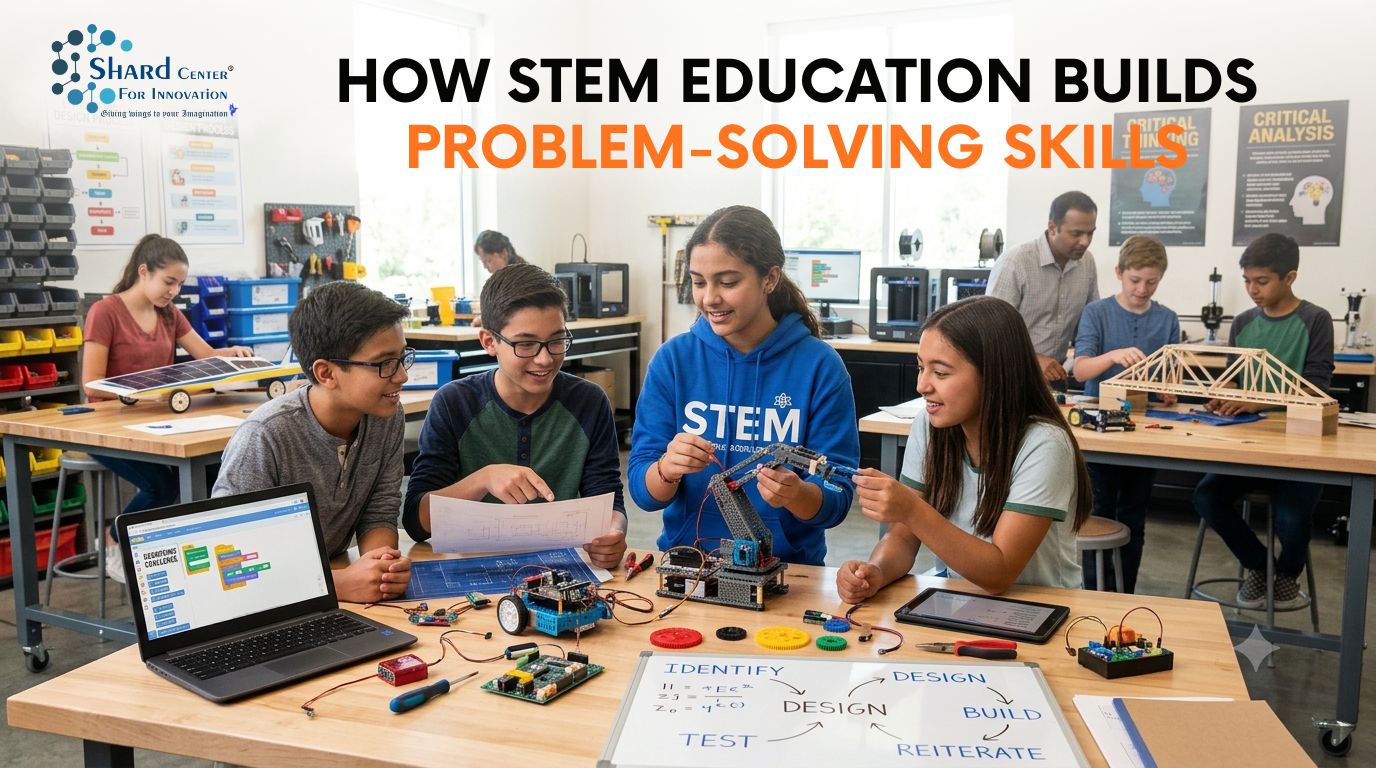
If you could give your child just one skill for the future, problem-solving would be a strong candidate. Technologies change, facts go out of date, entire industries appear and vanish — but the ability to face an unfamiliar problem and work out a solution stays valuable forever.
Here's the good news: problem-solving isn't a fixed talent some kids have and others don't. It's a skill, and it can be built. STEM education happens to be one of the best ways to build it. Here's exactly how.
(This article is part of our complete guide: STEM Education for Future-Ready Students.)
Why Problem-Solving Can't Be Taught by Lecture
You can't learn to solve problems by being told how. You learn it the way you learn to swim — by getting in the water and trying, again and again. That's the fundamental reason STEM is so effective: it's built around real problems children have to actually crack, not just read about.
Every STEM project is a problem in disguise. The robot won't turn. The code throws an error. The bridge collapses under weight. The AI keeps guessing wrong. Each one demands a solution — and in finding it, children practise the exact mental moves that make a strong problem-solver.
The Four Moves STEM Teaches
Good problem-solving follows a pattern, and STEM drills it naturally:
1. Break the problem down. Faced with "my robot doesn't work," a child learns to split it: Is it the power? The wiring? The code? This skill — called decomposition — turns one overwhelming problem into several solvable ones. It's the single most important problem-solving habit there is.
2. Look for patterns and clues. Children learn to gather evidence: What exactly is it doing? When does it fail? What changed? Instead of random guessing, they start reasoning from observation.
3. Form a hypothesis and test it. "I think the left motor isn't getting power — let me check." They make a focused change, test it, and see what happens. This is the scientific method, lived rather than memorised.
4. Learn from the result and iterate. If the fix works, great. If not, that's new information, and they go again. This loop — try, observe, adjust, repeat — is the engine of all problem-solving.
These moves transfer everywhere. A child who can debug a robot can debug a maths problem, a science experiment, a disagreement, or a plan that's gone sideways. (This is closely tied to the computational thinking we describe in Why Coding Is the New Literacy for Children.)
Failure: The Secret Ingredient
Here's what makes STEM uniquely good at this. In most of school, failure is something to avoid — a wrong answer, a red mark, a lower grade. In STEM, failure is built into the process. The robot is supposed to fail a few times before it works. The first prototype is meant to be flawed.
This reframes failure completely. Children stop fearing it and start using it. A crashed program isn't "I'm bad at this" — it's "interesting, let me find out why." That shift in mindset is one of the most valuable outcomes of a STEM education, and it's exactly the resilience that hands-on learning and robotics build so well.
It Also Builds Critical Thinking
Problem-solving and critical thinking grow together in STEM. As children test their ideas, they learn to ask sharper questions: Is this actually true? How do I know? What's the evidence? Could there be another explanation?
That habit of questioning and verifying — rather than accepting the first answer — is critical thinking in action. In an age of information overload and AI-generated content, the ability to evaluate whether something is reliable is more important than ever.
Why Employers and the Future Demand This
This isn't just educational theory. Problem-solving and analytical thinking consistently top the list of skills employers want. The World Economic Forum's Future of Jobs Report 2025 ranks analytical and creative thinking, alongside resilience and flexibility, among the most important core skills for the years ahead — precisely the abilities STEM builds. As routine tasks get automated, the uniquely human skill of solving novel problems becomes even more valuable. (We map where this leads in Career Opportunities in Robotics, AI, and Emerging Technologies.)
How to Encourage It at Home
You don't need a lab to nurture problem-solving. A few simple habits help:
•Resist giving answers. When your child is stuck, ask "what could you try?" instead of solving it for them. The struggle is where the learning happens.
•Praise the process, not just the result. "I love how you kept trying different ways" matters more than "you're so smart."
•Treat mistakes as normal. Let them see you make and fix your own errors calmly.
•Give open-ended challenges. Building, puzzles, and "how would you make this better?" questions all build the muscle.
The Takeaway
STEM education builds problem-solving by giving children real problems to solve — over and over — and teaching them the moves that crack them: break it down, look for clues, test a hypothesis, learn from the result. Along the way, it transforms their relationship with failure from fear to curiosity. That combination is arguably the most future-proof gift any education can offer.
Want to watch your child's problem-solving grow? Book a free demo class at a SHARD Center for Innovation near you and see them tackle a real challenge from start to finish.
Frequently Asked Questions (FAQs)
Q1 : Can problem-solving really be taught, or is it natural talent?
Ans : It can absolutely be taught. Problem-solving is a skill built through practice, and STEM provides constant, structured practice in tackling real challenges.
Q2 : How does failure help children learn problem-solving?
Ans : In STEM, failure is part of the process. It teaches children to diagnose what went wrong and try again, building both problem-solving ability and resilience.
Q3 : What age is best to start building problem-solving through STEM?
Ans : Early — even simple building and puzzle activities from age 6–7 develop the foundations, with more complex problem-solving growing through robotics and coding as children mature.
Q4 : Why is problem-solving an important skill for students?
Ans : Problem-solving helps students analyse situations, think logically, and find practical solutions. It is an essential skill for academic success, future careers, and everyday decision-making.
Q5 : How does STEM education improve critical thinking?
Ans : STEM education encourages students to ask questions, test ideas, analyse results, and make informed decisions. These activities naturally strengthen critical thinking and reasoning skills.
Q6 : Which STEM activities help develop problem-solving skills?
Ans : Robotics, coding, engineering design challenges, science experiments, AI projects, and mathematics-based activities all help students improve problem-solving through practical learning.
Q7 : Can STEM problem-solving skills help in everyday life?
Ans : Yes. STEM teaches students to break complex problems into smaller steps, evaluate different solutions, and make better decisions in both academic and real-life situations.
Q8 : How can parents encourage problem-solving skills at home?
Ans : Parents can encourage children to solve puzzles, build models, explore STEM kits, ask open-ended questions, and allow them to learn through trial and error instead of providing immediate answers.