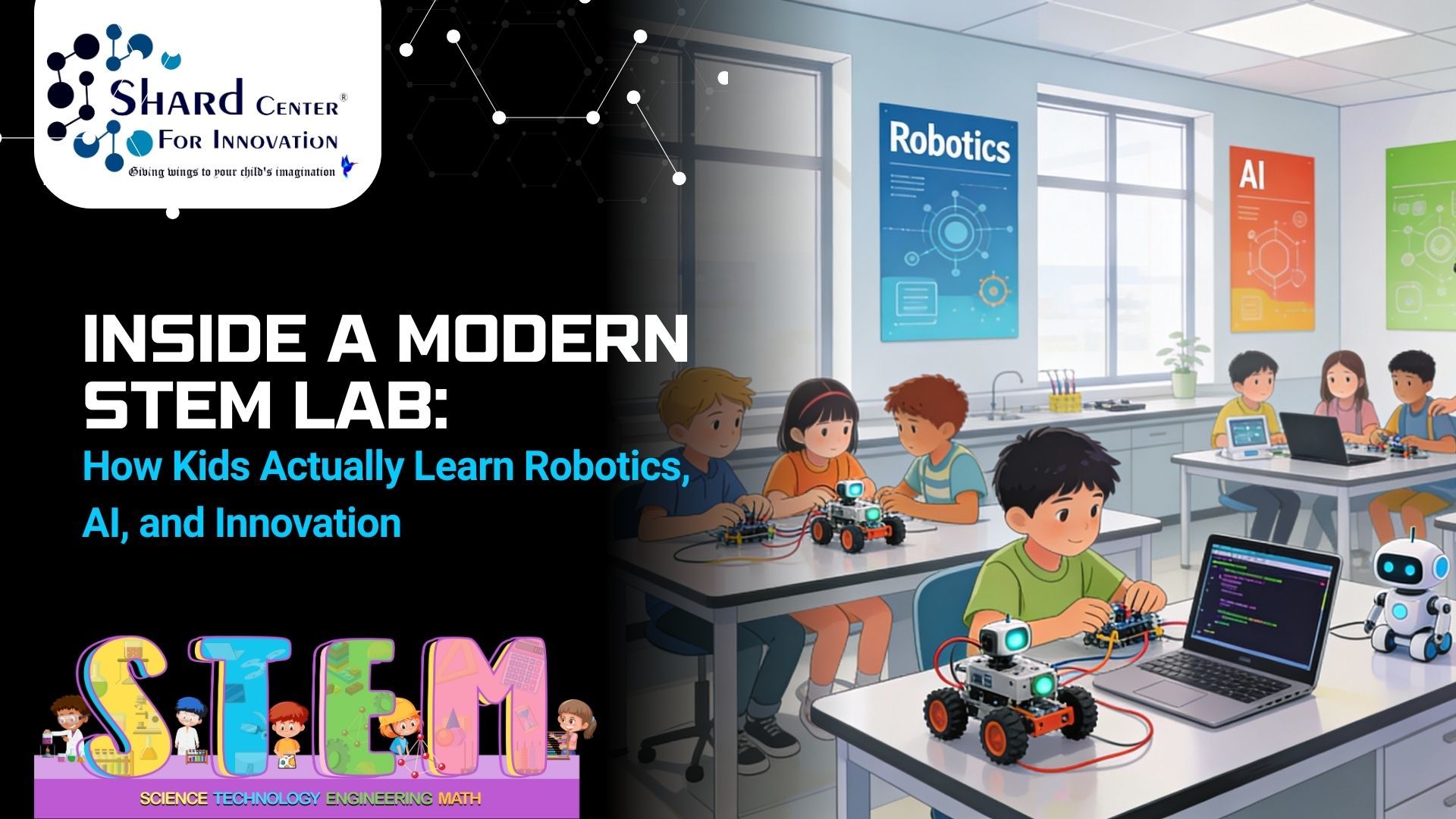
Parents want their children to be future-ready; however, very few of them understand how kids learn such skills as robotics, AI, and innovation. It is no longer sufficient to memorize concepts. The best way that children learn is through building, breaking, fixing, and trying. This blog describes the operation of a modern learning lab, what actually happens within a learning lab, and the reasons hands-on learning at SCIL Shard Center of Innovation can make children think, not just score better.
How Kids Learn in a STEM Lab (Not a Classroom)
In traditional classes, the teacher focuses on listening and writing. A STEM lab is different. In this case, learning occurs through action.
At a STEM center among children, they do not begin with theory. They start with a problem.
For example:
How come we could make a dustbin open automatically?
How do we know that a robot can follow a line on its own?
How does a machine see things?
Kids explore these questions using sensors, motors, and simple coding. Concepts of robotics, artificial intelligence, and innovation are introduced naturally during the process.
This method helps children:
Understand concepts deeply
Never be afraid to make mistakes.
Develop competence in problem-solving.
That’s why robotics classes for kids at SCIL focus on experience first, explanation second.
Robotics and AI Explained in a Kid-Friendly Way
Many parents worry that AI courses for kids or robotics may be too complex. In reality, they are taught in a very simple and visual way.
In a learning lab:
Robotics is taught as “making things move.”
AI is taught as “teaching machines to decide.”
Innovation is taught as “finding better solutions.”
Children work with:
Blocks of code that are easy to understand.
Real hardware like Arduino and sensors.
Team-based mini projects
Key skills kids develop:
Logical thinking
Creativity and imagination
Patience and focus
Teamwork and communication
In SCIL, each child is a learner at their own pace. No pressure. No competition. Simple, curiosity-based learning within a safe innovation children's laboratory.

Why Innovation Labs Matter More Than Online Courses
Videos can be used online to describe concepts; however, they cannot take the place of practical learning. Children: In a physical innovation institute, children:
Touch real components
See immediate results
Ask questions freely
Learn from peers and mentors
Innovation labs encourage:
Trial-and-error learning
Independent thinking
Ideas into real life.
Children who have taken STEM classes tend to exhibit the following to their parents:
Ask better questions
Be curious as to how things are.
Become more technologically comfortable.
This is the difference between learning about technology and learning with technology.
Conclusion
A learning lab is a place where curiosity becomes confidence. At Shard Center of Innovation, children do not learn robotics or AI; they learn how to think, create, and innovate. Now is the right moment to consider hands-on STEM learning in case you want your child to become a problem-solver and a creator rather than a technology consumer. Book a visit and see the difference yourself.