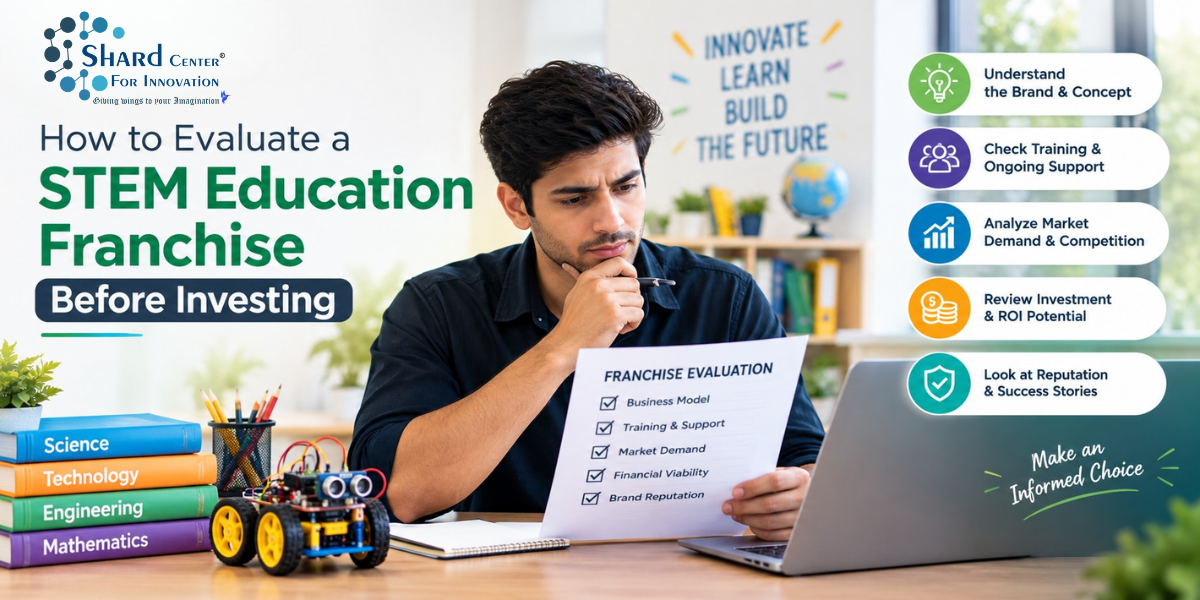
India has witnessed a robust demand for robotics, coding, AI, 3D printing, and hands-on learning. There are several franchise opportunities in the STEM sector today. However, guidance is required while selecting a STEM franchise business. How to Evaluate a STEM Education Franchise discusses the main factors that should be kept in mind while evaluating a prospective franchisee and how factors such as the quality of the learning product and the strength of the business model matter.
Why a STEM Education Franchise Requires a Different Due Diligence
A STEM education franchise is based on a business model that provides education services. This implies that more factors should be considered other than simply enquiring whether robotics, coding, and 3D printing are growing categories. A franchise in a good business environment can still be a poor choice if its curriculum is weak, unit economics are unrealistic, or the franchisor cannot support delivery.
It is useful to know that India has a big policy push towards experiential learning. According to CBSE’s 2026-2027 framework, it is necessary for schools to provide mandatory skill education for students in classes VI to VIII. Atal Innovation Mission has also established 10,000 Atal Tinkering Labs with engagement with more than 1.1 crore students. The relevance of STEM learning has been established across India, but it does not guarantee that an individual center may be profitable.
To make the most of the STEM franchise opportunities in India, investors should examine the educational product, target customers, local demand, business model, franchise investment, operational support, brand credibility, and legal agreement.
1. Start With the Educational Product
Prospective buyers need to understand the product being sold. They must inquire whether the franchise is an after-school center, a school partnership business, a lab-setup provider, a holiday program, a competition platform, or a combination of these. They should seek to know who the learner is, what they study, and what they hope to achieve after completing the program.
A franchise buyer should examine the curriculum offered. They should seek evidence of progression in the curriculum, as good programs allow beginners to develop foundations and have later modules introduce greater independence and complexity. How frequently the curriculum is reviewed should also be considered, as technology evolves quickly.
2. Does the Program Produce Real Student Work?
A good franchise provides valuable learning to both exceptional students and ordinary students. Prospective buyers should request examples of student work across age groups and seek evidence of progression from guided builds to independent problem-solving. How students are assessed and whether they understand the underlying concepts should be inquired. A good program should include documentation, presentations, and evidence of iterations.
This is a good commercial strategy too because parents and schools value a program when they can see visible outcomes.
3. Identify the Real Customer and Revenue Model
It is important to understand the business model and who the target customers are: whether they are the parents who pay for the classes, schools that buy the program and purchase the labs, students who attend camps, or institutions that pay for teacher training. These revenue streams have different sales cycles and cost structures.
For a center, buyers should inquire about the local household demographics, school density, competing activities, pricing sensitivity, seasonality, and the number of prospective students in the batches. For a school model, it is important to understand the procurement cycles, decision-makers, demonstration requirements, implementation capacity, and payment terms.
Read More: Why STEM and Robotics Franchises are the New Frontier for Indian Edupreneurs
4. Examine Unit Economics Line by Line
Prospective buyers should examine the complete model showing the initial franchise fees, interiors, equipment, deposits, licenses, launch marketing, working capital, and any mandatory purchases. Then disentangle fixed monthly costs from costs that increase with students. Revenue assumptions should be critically examined. It should be inquired how the number of enrollments is reached and how comparable centers have achieved the numbers of enrollments. Considerations such as what the average realized fees are, how many students renew, and what months are weak should be noted.
Franchisors should calculate break-even costs themselves for their centers.
5. Verify Existing Franchisee Performance
Talk with existing franchisees by asking the franchisor for contacts. Speak to a mixture of successful and average-performing centers. Ask them about their revenues and expenses, how useful the leads from the franchisors are, and what sort of curriculum support is provided. Rely on documentary evidence, and be willing to seek financial and legal advice where required.
6. Evaluate Training and Instructor Dependence
A good curriculum can become unsuccessful if instructors fail to explain concepts or manage a class. This is why a franchisee should understand the franchisor’s instructor profile, recruitment support, initial training, certification, and development. Inquire whether the lesson plans, facilitators, and project resources are standardized.
7. Look at Equipment, Maintenance, and Obsolescence
Franchisees should inspect who owns the STEM program equipment, such as robotics kits, computers, electronics, and 3D printing They should seek to know which purchases are compulsory, how warranties work, and whether replacement parts are easily available. For labs in schools, inquire about aspects related to installations, inventory control, maintenance visits, teacher handover, and annual support.
8. Audit the Marketing and Lead-Generation Promise
Inquire whether the franchisor provides digital support in terms of central campaigns, creative assets, local ads, and supply leads. If possible, request actual data on inquiries, qualified leads, trial classes, enrollments, acquisitions, cost, and renewal. Also seek to know what the brand's demand is by inspecting the website, social channels, reviews, and school partnerships.
9. Read the Franchise Agreement as a Business Document
Read the franchise agreement with due consideration, as it defines the relationship even when circumstances are difficult. Review the terms of territory, exclusivity, term, renewal, royalty, marketing fees, mandatory procurement, intellectual property, performance requirements, termination, and post-termination restrictions. Focus on the aspects that the franchisor is required to deliver.
10. Evaluate the Franchisor, Not Just the Franchise Package
A franchisee should holistically evaluate the franchisor and the relationship with the organization. It should examine the leadership, operating history, expertise, centers, or school clients, and how partners are supported.
For SHARD Center for Innovation or any other STEM franchise, investors should directly inquire from the franchisor about size, fees, support, and financial assumptions.
Creating a Scorecard
Investors should create a spreadsheet to inquire about the curriculum quality, market demand, unit economics, operating assistance, and contract risk. This enables a good judgment on behalf of the franchisee about the franchisor and their credentials.
The Key Takeaway
Prospective investors should seek to know whether the proposition is valuable and whether the local business can deliver that value. They should seek to know the quality of the curriculum, the student outcomes, customer segments, local demand, full investment, break-even assumptions, franchisee performance, equipment, marketing support, and the legal agreement. The goal is to identify a credible education provider who can deliver on these aspects.
Shard Center for Innovation delivers upon these criteria and ensures a seamless franchisee experience for investors. We provide both a center model as well as liaise with schools to set up innovative STEM labs on their campus. Inquire today about SCIL India’s offerings and dedicated support for investors.
Frequently Asked Questions (FAQs)
Q1: Is a STEM education franchise a good investment?
Ans: A STEM education franchise can be a good investment, depending upon the local demand, operator capability, and contract.
Q2: What should I ask a STEM franchisor before investing?
Ans: Enquire about the curriculum, total investment, recurring fees, unit economics, existing franchisee contacts, training systems, marketing support, equipment obligations, territory terms, and the full franchise agreement.
Q3: How should I verify franchise profitability?
Ans: To examine profitability, build a break-even model and speak with existing operators. Do not depend only upon the projected revenue in a sales presentation.
Q4: What is the biggest operational risk in a STEM education business?
Ans: A major risk is ensuring good quality of instructors and curriculum, equipment reliability and student retention.
Q5. How much space is required for a school STEM lab?
Ans: The required space depends on the number of students, activities, equipment, and lab layout. Schools should provide enough room for students to work safely on individual and group projects.
Q6. Can a STEM lab be used for different age groups?
Ans: Yes. Activities and equipment can be adapted for different age groups. Younger students can start with simple experiments and models, while older students can work on robotics, AI, coding, IoT, and advanced projects.
Q7. Do teachers need training to manage a STEM lab?
Ans: Teacher training can help educators understand the equipment, conduct practical activities, guide student projects, and connect lab activities with the school curriculum.
Q8. How can schools plan a STEM lab curriculum?
Ans: Schools can create a structured curriculum based on students' age, existing subjects, learning goals, available equipment, and project difficulty. The curriculum can progress from basic activities to more advanced projects.
Q9. What projects can students build in a STEM lab?
Ans: Students can build robots, smart devices, sensor-based systems, automated models, 3D-printed prototypes, coding projects, and solutions to real-world problems.
Q10. How can a school start setting up a STEM lab?
Ans: Schools can begin by defining learning objectives, assessing available space, selecting suitable equipment, planning the curriculum, training teachers, and creating a safe, project-based learning environment.
References
- Atal Innovation Mission – Atal Tinkering Labs Overview: https://www.aim.gov.in/atl-overview.php
- Atal Innovation Mission – ATL Impact: https://aim.gov.in/atl.php
- CBSE – Skill Education 2026–27: https://cbseacademic.nic.in/skill-education.html
- ERIC – 2025 Meta-analysis of STEM Integration and Academic Achievement: https://eric.ed.gov/?id=EJ1489580