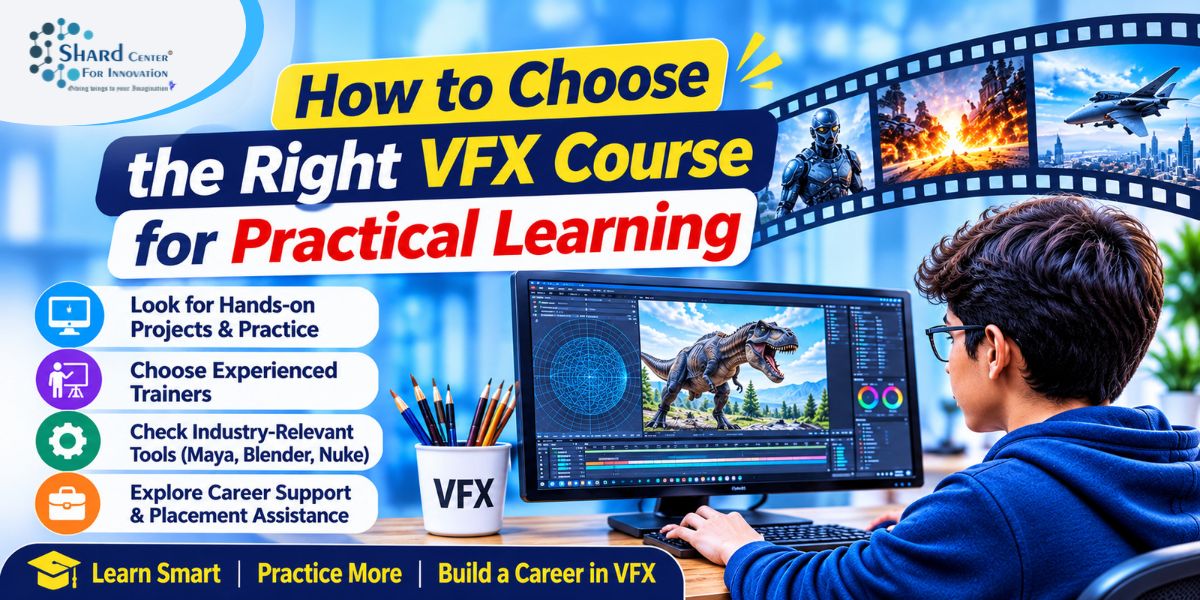
Visual Effects (VFX) tools are increasingly utilised by the entertainment industry, television shows, advertisements, web series and video games. They enable creators to develop realistic explosions, imaginary characters, and immaculate digital environments. As VFX is increasingly being utilised, many students are being attracted to VFX courses to develop their skills in this field.
However, the right VFX course should provide practical learning opportunities to the students, along with hands-on experience and industry-oriented skills. A few points should be kept in mind while selecting a VFX course.
1. Practical Training
A good course should involve practical training, with opportunities to apply these skills to real projects. The course should contain regular assignments, creative exercises, laboratory sessions and project-based learning. Students should be introduced to green-screen compositing, rotoscoping, motion tracking, 3D modelling, texturing and animation. The chance to practice through practical projects lets the learners be more confident and curious.
2. Choice of Software in the Curriculum
VFX professionals depend upon dedicated software to create special effects. The right course should provide a good training in the software that are commonly used in the industry.
Some software utilised by VFX professionals include:
·Autodesk Maya: For use in 3D modelling, animation and character development.
·Adobe After Effects: Utilised for motion graphics and visual effects.
·Nuke: Widely used for professional compositing.
·Blender: Used for 3D modelling, animation and rendering.
·Adobe Photoshop: Useful for digital painting, image manipulation and texturing.
·Houdini: Used for procedural effects, simulations and particle effects.
The training institute should provide opportunities to practice updated software versions for practical learning.
3. Evaluate the Course Curriculum
An industry-relevant VFX course should provide a holistic course that trains the learner in the many software applications that are relevant in visual effects production instead of just providing training in one software application.
Good programmes should include subjects such as:
·Fundamentals of visual effects
·2D and 3D animation
·3D modelling and texturing
·Lighting and rendering
·Rotoscoping and compositing
·Motion tracking and match moving
·Digital painting
·Special effects and simulations
·Video editing and post-production
A good curriculum should let students practice different stages of the VFX production pipeline and understand the role of each skill in the final project.
4. Examine the Institute's Infrastructure and Facilities
A training in VFX should encompass hardware, software and creative learning. To ensure a good learning experience, students should analyse the institute’s infrastructure. It must have computer laboratories, workstations, graphics tablets and licensed software. These facilities are vital for working on complex 3D projects, simulations and rendering assignments.
An institute should be chosen that provides sufficient laboratory access to practice independently outside scheduled classroom sessions.
5. Check Faculty Experience and Industry Exposure
The experience of instructors matters a lot in ensuring the quality of VFX education. Trainers should have sufficient professional industry experience so that they are able to explain production techniques, demonstrate practical workflows and help students understand industry expectations. Students should enquire about the faculty’s qualifications, teaching experience and professional backgrounds. They should go for institutes that organise industry interactions, guest lectures, workshops, studio visits and masterclasses. These activities enable students to learn from working professionals and understand industry trends.
Read more:- What Is VFX: A Beginner’s Guide to Visual Effects
6. Focus on Live Projects and Portfolio Development
It is important to curate a strong portfolio for joining the VFX workforce. Candidates are evaluated on the basis on their creative work output and practical abilities.
A good course should let students complete individual and collaborative projects throughout the programme, such as creating digital environments, compositing live-action footage, designing 3D characters and producing visual effects.
By the course end, students should have a collection of their best work which they can present through a professional demo reel or a digital portfolio. 
7. Availing Placement Support and Career Opportunities
Before selecting a VFX course, find more about the institute’s placement and industry connections. Placement support can help students identify opportunities and prepare for recruitment. The institute should provide resume-building sessions, portfolio reviews, interview preparation, internships and employer interactions.
A VFX course can lead to career opportunities such as:
·VFX Artist
·Compositor
·3D Modeller
·Rotoscopy Artist
·Lighting Artist
·Motion Graphics Designer
·Texture Artist
·Matchmove Artist
8. Course Fees and Student Reviews
Different institutes should be compared based on course duration, fees, teaching methods and facilities. Do not select a programme just because it is inexpensive and offers a short completion period.
Talk to current students and alumni to understand their experiences. Review student projects, online feedback and placement information to know about the quality of training included in the course.
The Key Takeaway
Selecting the right VFX course leads to a rewarding career in the creative industry. Students should make sure that the course includes practical training, updated software, experienced faculty, industry exposure and portfolio development while considering different programmes. A good course should combine technical knowledge with hands-on experience to develop confidence and skills to make a career in the VFX industry. A good VFX course encourages creativity, along with professional exposure and allows students to create meaningful VFX contributions.
Frequently Asked Questions
Q1. How can I choose the right VFX course for beginners?
Ans:Choose a course that covers VFX fundamentals, software training, practical exercises, and project-based learning. Beginners should look for a structured curriculum that gradually introduces advanced techniques.
Q2. What should a practical VFX course include?
Ans:A practical VFX course should include compositing, motion tracking, green screen techniques, 3D modelling, animation, rendering, and hands-on projects using industry-relevant software.
Q3. Which software should I learn in a VFX course?
Ans:Popular VFX software includes Blender, Autodesk Maya, Adobe After Effects, Nuke, Houdini, and Cinema 4D. The software you learn depends on your chosen specialisation.
Q4. Is practical training important in VFX education?
Ans:Yes, practical training helps students understand how visual effects techniques work in real projects. It also helps them develop technical skills, creativity, and confidence using VFX tools.
Q5. Can beginners join a VFX course without prior experience?
Ans:Yes. Many VFX courses are designed for beginners and start with basic concepts such as visual effects, compositing, animation, and software fundamentals.
Q6. How do I evaluate the curriculum of a VFX training institute?
Ans:Check whether the curriculum covers fundamental concepts, software tools, practical assignments, advanced techniques, and portfolio projects. A well-structured syllabus should clearly explain what you will learn at each stage.
Q7. How long does it take to learn VFX professionally?
Ans:Learning duration depends on the course structure, practice time, and your chosen specialisation. Developing professional-level skills generally requires consistent practice and experience working on projects.
Q8. Does a VFX course help students build a portfolio?
Ans:A project-based course can help students create portfolio pieces demonstrating their skills in compositing, animation, CGI, motion graphics, and visual effects.
Q9. What career opportunities are available after learning VFX?
Ans:VFX learners can explore roles such as VFX artist, compositor, 3D artist, motion graphics designer, FX artist, rotoscoping artist, and animation artist, depending on their skills and portfolio.
Q10. What should I check before taking admission to a VFX course?
Ans: Before admission, check the course syllabus, software covered, trainer experience, practical projects, lab facilities, duration, fees, student support, and portfolio development opportunities.