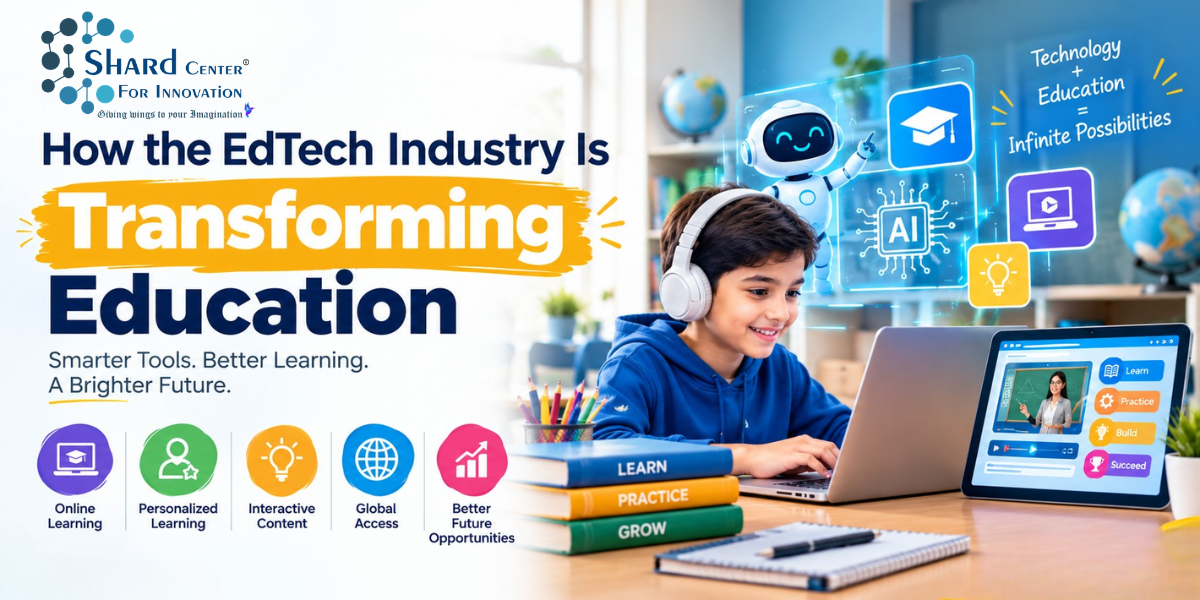
EdTech is revolutionizing education in India, moving across tables and teachers to immersive technologies that change the way education is accessed. This article discusses how this industry is moving education forward and reshaping it for students.
The Move towards Personalized Learning
EdTech has led to a shift away from “one-size-fits-all” style education towards a more equitable and personalized education. AI-led adaptive learning personalizes learning by ensuring that the teaching is aligned to the child’s pace of learning (TCS). We have explored this further in the article How EdTech Is Making Learning More Personalized
Breaking Down Barriers of Access
EdTech is making education more equitable and accessible, which has several advantageous outcomes in a country like India, where now a student living in a remote rural region can access the same content as someone living in a metropolitan city. Learning in tier-2 and tier-3 cities has also been transformed due to falling data costs and increasing availability of smartphones. EdTech has successfully offered learning opportunities to millions of students.
Making Learning Engaging
EdTech has led to learning being more engaging and interactive due to innovations such as gamification, which greatly motivates students; interactive content such as videos and simulations; and immersive technologies such as augmented reality and virtual reality, which offer experiential learning to students. These innovations let students enjoy studying and be more attentive and interested in academic learning.
Instant Feedback and Data-Driven Insights
EdTech works on a framework that makes instant feedback for students possible by generating data on student learning. This data can be shared with teachers and parents to understand where a student is underperforming. These insights can help prepare children for their tests and exams and support all kinds of students.
Extending Learning Beyond the Classroom
EdTech makes learning accessible by providing flexible education beyond the walls of the classroom. It allows lifelong learning by letting professionals keep upskilling themselves.
Enabling and Not Replacing Teachers
A common misunderstanding is that EdTech replaces teachers due to providing learning options that often resemble classroom learning. However, EdTech empowers rather than seeks to replace teachers. It offers several advantages to teachers by freeing them and letting them focus more on direct mentoring while letting technology handle repetitive tasks such as grading and tracking the progress of students. This is the direction that the Ed-Tech revolution is guiding the education ecosystem towards.
From Consuming to Creating
There is a transformative shift in the education ecosystem, as students are being encouraged to become creators of technology rather than being consumers of it. Robotics kits, coding platforms, and virtual labs develop students into innovators as they learn. This is the thinking behind many offerings of SHARD's STEM education franchise and AI and robotics learning, which provide programs at the frontier of the tech revolution.
The Key Takeaway
The EdTech revolution offers several benefits to learners and educators by making education more accessible, equitable, and convenient admissions. It seeks to empower rather than replace students and offers the best results when good teaching is paired with hands-on experiential learning.
For a complete picture, see our guide: EdTech in India: The Complete Guide
FAQs (Frequently Asked Questions.)
Q1. What is EdTech?
Ans: EdTech, or educational technology, encompasses technologies, media, and academic software that are used to further teaching, learning, and educational processes.
Q2. How is EdTech revolutionizing the education sector?
Ans: Education technology is redefining learning and the classroom experience by introducing elements of interactivity, flexibility, accessibility, and personalization through digital media, academic software, online courses, and other edtech tools.
Q3. What are the primary benefits of EdTech?
Ans: Students can access information at their own pace when using educational software and can further reinforce what they learned through digital activities and other interactive means.
Q4. How are AI and big data used in EdTech?
Ans: AI can be utilized to offer adaptive learning, provide feedback, offer recommendations, and more through the use of powerful algorithms. Similarly, big data can offer valuable insights into students’ behaviors and learning patterns.
5. Can EdTech be used to encourage real-world applications of learned knowledge?
Ans: Yes, educational technology can be used to promote deeper understanding of the material and encourage real-world applications through activities such as coding, robotics, simulations, and more.
Q6. How can educational technology benefit teachers?
Ans: Through the utilization of edtech tools, teachers can communicate with their students, provide information and materials, get feedback, grade, monitor, and more.
Q7. How is EdTech beneficial to STEM fields?
Ans: EdTech can be utilized for coding, robotics, AI, simulation-based learning, and other activities related to the STEM fields.
Q8. What are some of the biggest threats and challenges of EdTech?
Ans: Potential threats and challenges include issues with internet access or electronic devices, screen time, privacy, and other similar concerns.
Q9. Will EdTech replace traditional professors and teachers?
Ans: No. Although edtech tools are very powerful, they can augment and aid the learning process but cannot replace the role of human educators and mentors.
Q10. What can you say about the future of the EdTech industry?
Ans: The field of educational technology will continue to grow and evolve and will introduce new developments and innovations that will further change and improve the educational landscape. It will continue to provide students and teachers with powerful tools and new opportunities.