Introduction
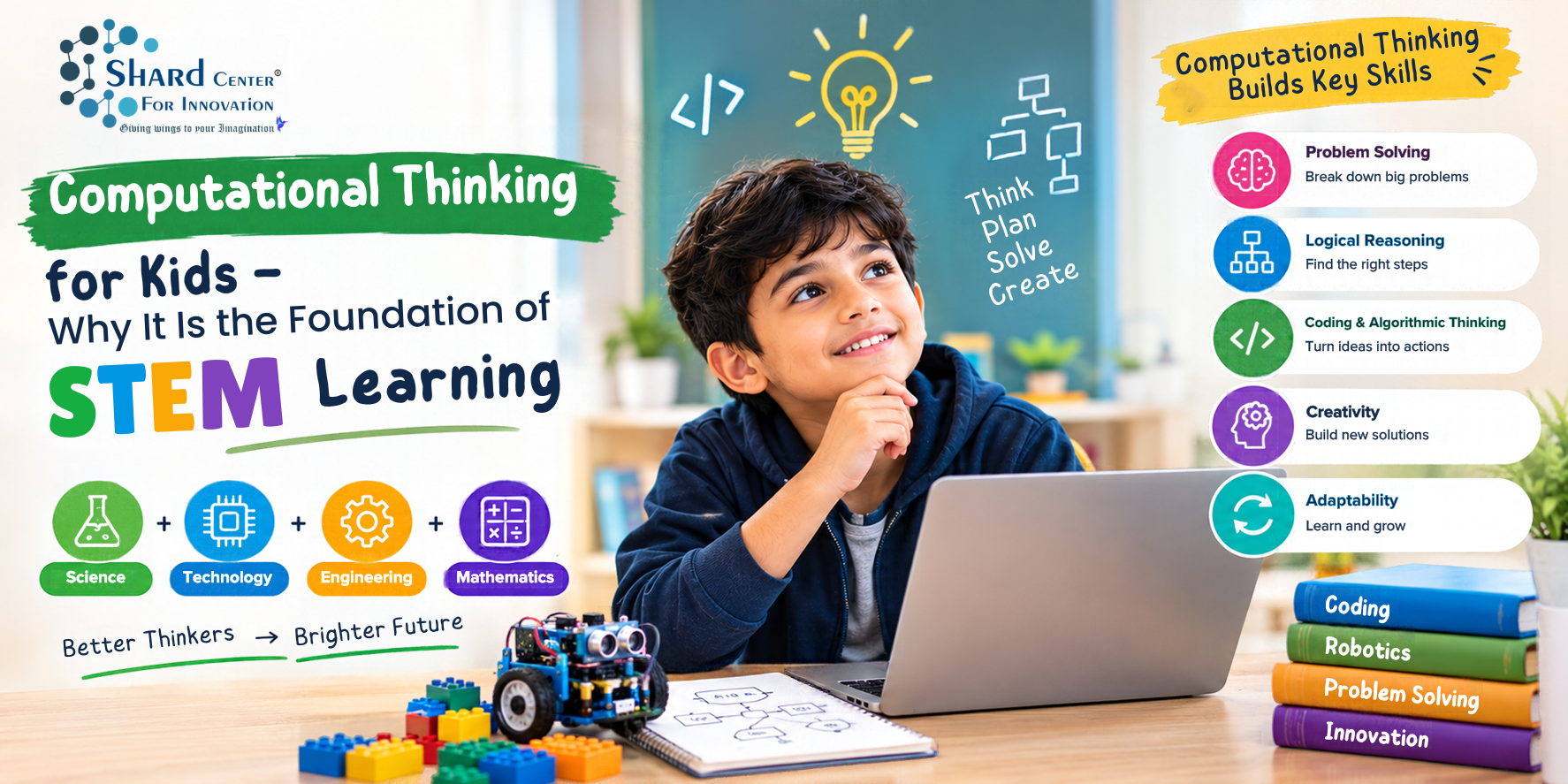
In today’s tech-driven world, knowing how to use technology is not necessarily enough. Children require problem-solving skills and the ability to turn ideas into solutions. This is where computational thinking becomes important – it is a method of approaching problems by using logic and creativity and allows children to build these skills early on. It can effectively build a foundation for learning science, technology, engineering and mathematics (STEM).
What Is Computational Thinking?
Computation thinking involves a systemic way of approaching any problem. It allows students to break a big challenge into smaller aspects and mainly involves four skills: decomposition (dividing a problem into smaller parts), pattern recognition (or spotting similarities), abstraction (focusing on the most important information) and algorithms (creating step-by-step instructions). These ideas do not require a computer to be learned.
Why Is It Important for Kids?
Computational thinking is important for kids because it is utilised by children in simple day to day activities such as organizing toys, following a recipe or planning a route. Children learn to observe, ask questions and test ideas, and greatly improve their confidence, curiosity and persistence. Mistakes are viewed as useful cues that let them find a better solution.
The Connection Between Computational Thinking and STEM
Computational thinking supports and provides the skills required for STEM learning. Science lets children make predictions and conduct experiments, while technology lets them create basic sequences, explore coding, or create a small robot. Engineering allows students to design a bridge from craft materials and redesign it after testing it, while mathematics lets them recognise patterns, sort objects and follow logical steps to solve problems. Computational thinking skills connect these subjects and help students understand how they work in tandem.
Fun Ways to Build the Skill
Computational thinking can be made playful and practical. Let students list the steps involved in brushing their teeth or making a sandwich. Let them sort buttons by colours, shape or size, and build paper towers. Activities such as playing board games, puzzles, treasure hunts, block building and age-appropriate coding activities also help with developing sequencing and logical reasoning. The goal is to find different ways to solve a challenge.
Conclusion
Computational thinking is a life skill that helps students become problem-solvers who can recognise patterns, break down challenges, test ideas and learn from outcomes. These thinking habits can be introduced through play and hands-on STEM activities, which can help build a stronger foundation for the future. Complex problems become easier when they are approached one step at a time. At Shard Center for Innovation, computational thinking forms the bedrock behind different STEM initiatives such as Robotics, Drone Technology, 3D Printing and Artificial Intelligence.
Frequently Asked Questions (FAQs)
Q1. What is computational thinking for kids?
Ans: Computational thinking is a problem-solving approach that helps children break down a complex problem into small steps and detect patterns to come up with a solution.
Q2. Why is computational thinking important for children?
Ans: It helps them develop logic, creativity, analytical and problem-solving skills that can help them learn STEM (Science, Technology, Engineering, Mathematics) subjects with ease.
Q3. How is computational thinking related to STEM education?
Ans: It helps children to think and act like computer scientists to understand how the world works through engaging in rich learning experiences.
Q4. At what age can children start learning computational thinking?
Ans: Kids can begin to learn and practise decomposition, pattern recognition, and other important foundational concepts through simple puzzles, sequencing activities, and other appropriate exercises at a young age.
Q5. Does computational thinking require coding?
Ans: No. While coding is an important skill for kids to learn, computational thinking can be applied in many areas of life. Pattern recognition, puzzles, and simple logic games can help kids develop some very basic concepts of computational thinking.
Q6. What are the four main concepts of computational thinking?
Ans: Decomposition, pattern recognition, abstraction, and algorithm design are the four fundamental concepts of computational thinking.
Q7. How can parents develop computational thinking at home?
Ans: Parents can help children to play puzzles, detect patterns, follow instructions and directions, organize things, solve logic-based riddles, and tell them how they arrived at the solution to various problems.
Q8. How does computational thinking help in robotics and coding?
Ans: It helps children to develop the skills to break down a problem into smaller parts, provide instructions to the robot or a computer, detect errors in the programs and improve on them.
Q9. What activities help children develop computational thinking?
Ans: Unplugged coding games, puzzles, block coding activities, robotics challenges, mazes, and design activities are some of the fun activities that can help a child develop computational thinking skills.
Q10. How does computational thinking prepare children for future careers?
Ans: The core skills required in computational thinking are easily transferable to most disciplines, including robot-coding, computer science, software development, and other allied fields.