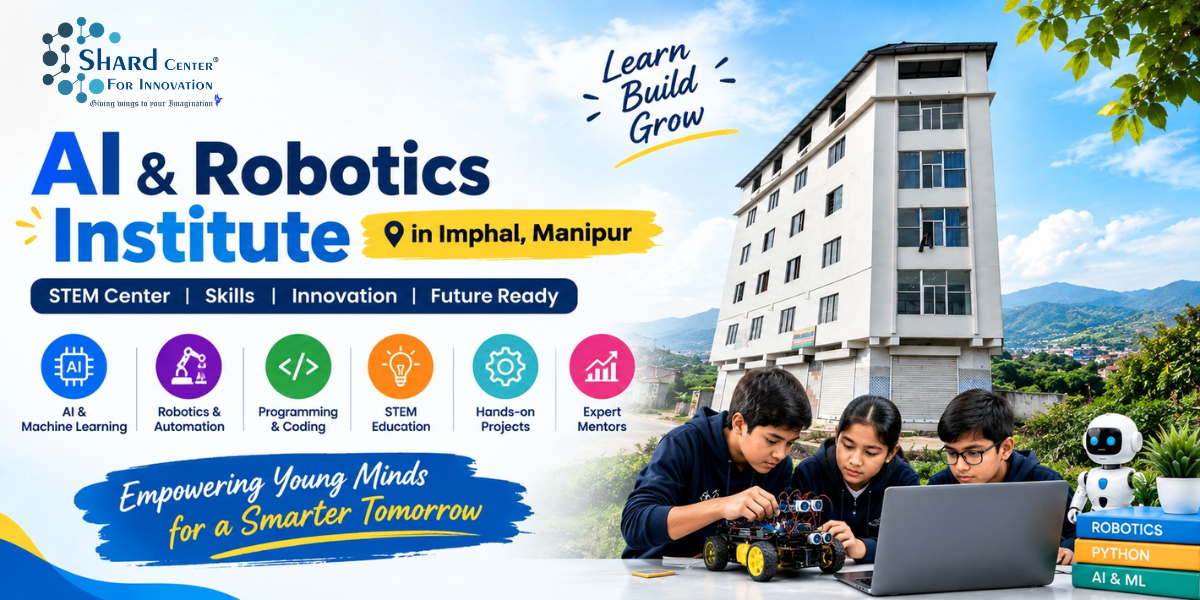
Students learn about AI and robotics better through practical experiments. At an AI & Robotics Institute in Imphal, students get to build and test their own ideas by engaging in projects that allow them to troubleshoot and improve on their own rather than a theoretical approach.
Technology is transforming the student learning, creating, and solving processes each day. Getting hands-on experience with artificial intelligence, robotics, coding, machine learning, drones, IoT, and 3D printing can give students in Imphal a glimpse into how the concepts taught in school can apply to real-world technologies.
A competent AI and robotics training institute in Imphal will offer interactive activities that stimulate creativity, programming, and problem-solving abilities in students. Through these practical sessions, students can develop a deeper understanding and practical experience with the technologies that will shape the future of education and many other fields.
Why are AI & robotics important for students learning?
Hands-on AI & robotics education enables students to develop key skills beyond the theory of concepts. Having to build a project requires them to identify problems, plan their approach, test their ideas, deal with mistakes, and communicate their results.
Shard Center for Innovation describes its learning model based on experiential and hands-on education at the AI & ML Institute for Kids India in emerging technologies. Its wider program portfolio has AI, ML, drones, 3D printing, data science, IoT, and robotics.
For parents, the question should not be whether a center offers a particular course, but whether students get exposure to practical training, suitable mentoring, age-appropriate learning, project opportunities, and course objectives.
The Role of AI & Robotics in Future Skill Development
AI & robotics education should not be seen as just the preparation for a specific career. Its value lies in preparing students to be comfortable with experimentation, technology, structured thinking, and problem-solving.
As technology advances, students can expect to learn and experiment with new tools and applications as they progress in their education and career. A good AI & robotics foundation can make it easier for them to learn new technologies later.
However, the best AI and ML programs for kids in India should be balanced. Children benefit from communication, creativity, teamwork, and other broader learning experiences. Technology education is best when it complements overall development rather than just being a set of technical lessons.
According to Shard Center for Innovation's Imphal Center admission information, its programs include robotics, AI, machine learning, drones, 3D printing, IoT, and data science. The center also describes its approach as hands-on and project-based, with students working with robotics kits, AI software, drones, and other technology tools.
STEM Institute Students Can Explore
A modern STEM center can offer a mix of technology-focused learning programs. The exact subjects depend on the center and the student's age.
AI & ML
AI education can help students to understand the basics of intelligent systems, data, pattern recognition, and automation. Older students can delve into programming and machine learning concepts.
Robotics and Coding
Robotics has programming, electronics, sensors, mechanics, and automation as its key elements. Students can learn the concepts by building and testing simple robots and interactive projects. Coding plays an important role in STEM education. Beginner-friendly coding activities can enable students to develop knowledge of logic, sequencing, problem-solving, and computational thinking.
3D Design
3D design and printing can introduce students to digital design, prototyping, and product development. 3D Printing Courses for Kids They can create a digital model and understand how an idea can be turned into a physical object.
Internet of Things
Basic IoT classes for kids' and projects can help students to understand sensors, circuits, connectivity, and automation. These activities can be particularly beneficial for learners who enjoy building and experimenting with physical technology.
Drone Technology
Drone technology deals with drones—unmanned aircraft that can be remotely controlled and/or programmed to carry out various tasks. Students can engage in drone technology activities to get familiar with notions of flight and diving, various sensors, programming, navigation, and electronics.
Data Science
The data science discipline teaches students how data may be gathered, organized, manipulated, and analyzed to make particular conclusions. Students will be able to explore concepts of data analysis, visualization, statistics, and machine learning throughout the classes, as well as important reasoning skills.
Architecture & Visualization
The architecture and visualization course helps students to transform their ideas into visually compelling digital designs. Using modeling and rendering software, students can explore design possibilities, hone their spatial relations skills, and learn to communicate their ideas to others.
Compositing & VFX
Students in the compositing and VFX class will be able to examine the production of digital effects in media and entertainment. By integrating photographic elements, animation, video, and graphic elements, students will be able to explore the production of digital composites and motion pictures throughout the curriculum.
Building Future-Ready Skills in Imphal
AI and robotics education are most useful when students learn how to apply technology rather than just learn the technical terms. A project such as a sensor-based robot, an automated system, or a simple AI application can enable them to gain experience with planning and experimentation.
For students in Imphal who want to explore emerging technologies, Young Scientists Programme offers programs designed around AI, robotics, and other technology areas. The center's Imphal page also emphasizes beginner-friendly learning, practical projects, and hands-on accessibility to technology equipment.
Its key benefits include:
Practical Learning: Students can learn by building models, testing their ideas, and working on real projects.
Technology Skills: Students can explore coding, robotics, AI, electronics, and other modern technologies.
Problem-Solving: Hands-on activities promote the identification of problems and seeking practical solutions.
Creative Thinking: Project-based learning allows students to explore their ideas and experiment.
Logical Thinking: Coding and technology activities can improve reasoning and structured thinking.
Learning by Experimenting: Students can test their ideas, learn mistakes, and improve their projects.
Greater Engagement: Practical activities can make technology learning engaging and interactive.
Future Readiness: Exposure to STEM can help students be more exposed to emerging technologies.
Why Choose Shard Center for Innovation?
Students at Shard Center for Innovation could benefit from gaining practical insights into AI, coding, drones, and robotics, including machine learning, IoT, and 3D printing. Project-based learning promotes creativity, critical thinking, teamwork, and problem-solving abilities.
Students can learn academic ideas and real-life applications through project-based learning. Students in best innovators in Imphal can benefit from structured STEM education to prepare for future studies and advance their comprehension of the fields of expertise, including STEM, AI, and robotics.
Start exploring Best STEM Center in Imphal, Manipur, to help students turn their curiosity into practical skills.
Frequently Asked Questions
Q1. Is AI and robotics learning appropriate for beginners?
Ans: Yes, novices may begin with fundamentals and advance to more complex applications and actual-world projects. Shard Center for Innovation provides cutting-edge learning experiences that enable students to acquire new expertise from the ground up.
Q2. Which technologies may students learn?
Ans: Shard Center for Innovation provides students with technology-related learning opportunities, including AI, robotics, machine learning, drones, IoT, 3D printing, coding, and data science.
Q3. Are hands-on experiences and projects a component of these programs?
Ans: Yes, students may engage in robotics and AI kits, drones, and other technology-related activities and projects.
Q4. What competencies can students develop by participating in AI and robotics?
Ans: Students may acquire numerous abilities from robotics and AI, including coding, problem-solving, logical reasoning, creativity, critical thinking, collaboration, and project-building.
Q5. Who can participate in AI and robotics programs?
Ans: Anyone may benefit from AI and robotics programs. Novices who are unfamiliar with the principles of AI and robotics may participate and progressively acquire new expertise.
Q6. How can project-based learning experiences benefit students?
Ans: Project-based students may obtain actual-world experience designing, constructing, testing, and evaluating solutions and identifying areas for enhancement.
Q7. Can students learn about drones and IoT?
Ans: Yes, students may acquire knowledge of drones and IoT as a part of robotics and AI-based learning initiatives.
Q8. Why is STEM-based education crucial, and how may it benefit students?
Ans: STEM education is critical since it enables students to obtain competencies in science, technology, engineering, and mathematics through practical application and develop additional abilities, including creativity and critical thinking.
Q9. Can robotics and AI programs help students pursue STEM careers?
Ans: Yes, since students may acquire a comprehensive understanding of the concepts and actual-world applications of robotics, AI, and related technologies, such as drones and 3D printing, earlier.
Q10. Where can parents find information about the available courses?
Ans: Parents may go to the Shard Center for Innovation website to obtain information about the programs and courses provided and the enrollment procedures.