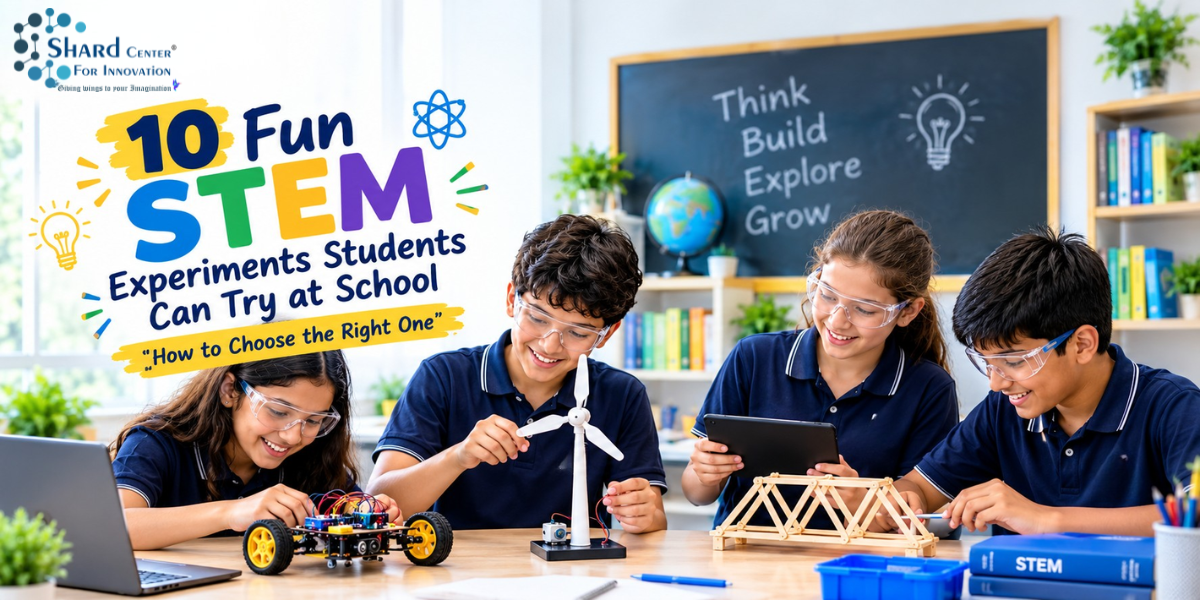
10 Fun STEM Experiments Students Can Try at School lists experiments that develop students' understanding and confidence and hone their ability to solve unfamiliar problems. This article offers examples of activities that students can perform to improve their understanding of STEM topics in a fun way.
1. Build a Paper Bridge and Test Its Strength
Children can perform this activity by working with time constraints, limited materials, and performance targets. Students should sketch ideas before building the bridge and compare results with the original drawings. They can work in teams and plan to bring an original plan to life. They should document both their successful and unsuccessful attempts, as unsuccessful attempts also provide evidence of understanding if students can successfully revise the plan to remove the issues. Teachers should assess the iterative process and not just the look of the final model. An attempt should be made to gauge students’ understanding through the STEM experiments.
2. Design a Balloon-Powered Car
Students should be provided with cardboard, straws, bottle-cap wheels, tape, and a balloon and should decide, in teams of students, how to attach the axles and direct the escaping air. The distance travelled should be measured, and then one design variable such as wheel alignment or mass should be changed. Students should be able to explain that a balloon stores energy and escaping air provides thrust; friction and alignment affect how far the car travels.
Students should be urged to connect the activity to a concept encountered in study, such as forces, algorithms, materials, data, ratios, or communication. Teachers should judge the iterative process along with the appearance of the final model.
Read more: Computational Thinking for Kids—Why It Is the Foundation of STEM Learning
3. Create a Straw Tower That Holds Weight
Students should be provided with straws and encouraged to build a tower that can hold the weight of small objects. This activity teaches them how to balance and build with straws and allows them to test how structures work. They learn about forces and stability while using evidence to solve an engineering problem. Through this activity, children discover the role of gravity in pulling things downward and explore concepts in engineering such as design and stability as they experiment with different shapes, heights, and supports. Building a tower is also iterative: they may need to modify and rebuild their towers in order to have them support different weights.
4. Explore Water Filtration With Everyday Materials
Students can use filter paper, gravel, and sand to learn how particles are removed from muddy water. This activity encourages them to think about why water that looks clear after filtration may still be unsafe to drink. It also helps them understand the importance of potable water treatment, as physical filtration alone cannot remove all harmful microorganisms and contaminants. When planning How to Set Up a STEM Lab in Your School: A Complete Guide, activities like this can help teachers connect scientific concepts with everyday life and environmental sustainability. Students can compare different filtration materials, record their observations, and repeat the process by changing one material at a time to understand how each material affects the results.
5. Build a Simple Electric Circuit
Children can build a complete electric circuit by using low-voltage batteries, insulated wires, an LED, and an appropriate resistor. They should be motivated to inquire what happens when the circuit path is interrupted. A classroom beginner activity should not be conducted using mains electricity. This activity encourages students to inquire how an electric circuit operates and conducts electricity through it and which conditions make an electric component such as a bulb work. It allows children to learn about electricity, conductors, insulators, and circuit designs. Children observe the outcome and explain what leads to a bulb or electrical equipment working.
6. Make a Paper Helicopter and Investigate Flight
This is a simple STEM activity that students can easily perform in classrooms and laboratories. This experiment allows children to experiment with how air resistance, gravity, and model design work together to give flight to the object. Children understand how gravity pulls the object downward, while air resistance affects its movement through air. They can observe the outcomes and how the helicopter moves after changing its designs.
7. Test Insulation with Ice Cubes
Students can test insulation with ice cubes to understand how different materials slow down the transfer of heat and keep objects cool. This experiment helps students understand how heat moves from warmer surroundings to colder objects and how insulating materials help slow down the transfer of heat. Children can compare the insulation of different materials by placing wrapped ice cubes in different materials in the same environment and noting how fast or slow the ice melts in the different materials. The activity combines mathematics, physics, and problem solving in a simple, low-cost experiment.
8. Investigate Plant Growth and Light
This experiment allows students to learn how plants grow and the factors that influence their growth and collect data to note the changes that occur over time. Children can test how conditions such as sunlight, water, or soil affect plant height. They can form a hypothesis and observe how changing growing conditions impact the plant’s development. Students can record their findings and compare growth rates to identify patterns.
9. Create a Balloon Static-Electricity Experiment
Students can rub an inflated balloon with a dry cloth and understand how it attracts paper pieces. They can test the effect of distance, material, and rubbing time upon the observation. This experiment allows students to understand how static electricity functions and how electric charges can attract objects. They can also discuss charge transfers in simple language.
10. Design a Marble Run
Designing a marble run enables students to understand how gravity, slopes, friction, and the design of a track affect the movement and speed of a marble. It allows children to predict how changes in height and surface material will affect its movement. They can test their ideas and improve the track based upon evidence.
How SHARD Can Support Meaningful STEM Learning
SHARD Center for Innovation can develop these ideas as a framework for explaining its STEM learning. A useful call to action is to invite schools to discuss age-appropriate projects, curriculum integration, and facilitator support, as SHARD can support schools in setting up their own STEM labs with its support.
Frequently Asked Questions (FAQs)
Q.1. What is the main benefit of STEM experiments for students?
Ans: STEM experiments familiarize students with scientific concepts in a hands-on way by allowing them to apply ideas, test them and improve their solutions.
Q.2. At what age can students start STEM experiments for students?
Ans: Students can start guided activities in primary school and increase their independence and technical complexity as they progress further.
Q.3. Do STEM experiments for students require expensive equipment?
Ans: Not necessarily. All the experiments mentioned in this blog require very minimal-costing equipment that serves the learning goals.
Q.4. How should schools evaluate student progress?
Ans: Schools should examine the problem definition, planning, testing, explanation, collaboration, and revision, and not only whether a finished project works.
Q.5. How do STEM activities develop problem-solving skills?
Ans: Students identify a problem, test different ideas, observe results, and improve their designs based on what they learn.
Q.6. Are STEM experiments suitable for beginners?
Ans: Yes. Teachers can introduce simple activities first and gradually move to more advanced projects involving robotics, coding, electronics, and engineering.
Q.7. What is the role of teachers in STEM experiments?
Ans: Teachers guide students, explain concepts, encourage questions, and help them test ideas safely rather than simply providing the answers.
Q.8. How can schools introduce more STEM activities?
Ans: Schools can organize project-based lessons, classroom experiments, robotics activities, coding exercises, and group challenges using age-appropriate materials.
Q.9. What safety precautions should students follow during STEM experiments?
Ans: Students should follow teacher instructions, use suitable materials, wear protective equipment when needed, and avoid dangerous chemicals, open flames, or unsafe electrical connections.
Q.10. Can STEM experiments encourage students to pursue technology courses?
Ans: Yes. Hands-on activities can introduce students to robotics, artificial intelligence, coding, electronics, and other technology fields, helping them explore their interests.
Sources
- https://www.sciencebuddies.org/blog/engineering-challenges-elementary-school
- https://www.sciencebuddies.org/teacher-resources/lesson-plans/paper-bridge-design
- https://www.sciencebuddies.org/teacher-resources/lesson-plans/balloon-car
- https://code.org/en-US/curriculum
- https://studio.code.org/courses/ai-foundations-exploring-ai-and-cs-2026/units/6/lessons/2